Showing posts with label yahoo. Show all posts

Sunday, November 3, 2013

The 2013 Mercedes-Benz CLA45 AMG’s big bark: Motoramic TV

The words “four cylinder” and “AMG” sit uneasy in close proximity. Four-cylinder engines are cheap, economical workhorses that, in their rare upmarket appearances, serve as fuel-economy specials. In a performance context, four-bangers connote the sport compact crowd — Hondas, GTIs and rally cars. None of those Venn diagrams overlap the territory of AMG, Mercedes-Benz’ cathedral to big horsepower and bigger money. Right now, if you want a four-cylinder AMG, one of your options is to cut an SL65 motor into thirds.

But come November there’ll be an easier path to quad-piston AMG entertainment. The 2.0-liter four-banger beneath the hood of the CLA45 AMG pumps out 355 hp, 332 lb-ft of torque and a truly bratty exhaust note. AMG’s littlest motor claims a bunch of production-car superlatives, including highest specific output (178 horsepower per liter) and highest boost pressure (26.1 psi). I’m guessing you’ll want to fill up with premium.

Mercedes introduced the CLA45 AMG at the new Bilster Berg race track in Germany. Nestled amongst quaint storybook hills where you can easily imagine witches getting pushed into ovens, Bilster Berg is a merciless succession of blind corners and drastic elevation changes. It’s certainly not a track to flatter your abilities or mask a car’s shortcomings. And while Mercedes led the CLA-driving ducklings around the track with a pace car, that pace car was an SLS AMG driven by a fellow who seemed to occasionally forget that he had an SLS while we had CLAs. A rolling roadblock he wasn’t.

That stacked two-liter motor sends its power through a seven-speed dual-clutch transmission and all-wheel-drive. The latter is not a totally tricked-out torque-vectoring physics-rearranger like you’d find in a Mitsubishi Evo — this system is here to launch you off the line, banish torque steer and get you up to the ski condo. Under normal running, it’s 100 percent front-wheel-drive, but the system can push up to 50 percent of the torque rearward. Even so, there’s no rear torque bias and consequently never any power oversteer. You can pitch the tail out with lift throttle and a sudden yank of the wheel, but it would probably take a dirt road and serious left-foot rally techniques to drift a CLA45 around a corner. The brake-based Curve Dynamic Assist, which is active even with stability controls off, does offer brake-based torque vectoring to help tidy your line.

AMG models used to be all about the motor, but lately they’ve become well-rounded packages as the AMG goblins get their hands deeper and deeper into the development cycle. Indeed, if you had a front-end collision in your CLA45 AMG, I don’t think the repair place could use many CLA250 parts in the rebuild — engine, cooling, suspension, brakes, aero trim and many other parts are AMG-specific. And yet, the motor still dominates the experience.

Stomp the gas, listen to the exhaust fire off a couple of angry blats and you’ve done 0-60 mph in 4.5 seconds. That’s a very legit number, and one that’s comfortably ahead of the larger six-cylinder cars that compete at the CLA45’s $50,000 price range.

I suppose we’ll soon find out whether the high-performance Benz crowd embraces a car with a mere two liters beneath the hood, but I like Mercedes’ angle. There are enough V-6-powered, 300-or-so horsepower sport sedans in the world. There aren’t enough wildly boosted German four-cylinders that bark and pop like a World Rally Championship car. Besides, a four-cylinder that outruns sixes: that’s very AMG.


Source: Yahoo!

Subaru Viziv concept projects an angular, angrier future

The Subaru Viziv Concept revealed at the Geneva Motor Show showcases the brand’s ideas for a future-generation crossover. It has two-doors, four seats, and draws its name from “vision for innovation.” It also appears a little reminiscent of Kia’s Cross GT concept from earlier this year: only better looking, smaller and less Korean.

It looks futuristic, as most concepts do, but retains some features – like the rear end – that appears modern and relatable. The interior boasts custom displays for each of the vehicles occupants, along with Subaru’s EyeSight stereo camera system.

For the engine, Subaru chose a plug-in hybrid design, utilizing a 2.0-liter Boxer diesel motor powering the front axle and two independent electric motors to spin the rear. This design saves weight, but more importantly, eliminates the need for a propeller shaft, meaning the designers could lower the floor and increase passenger legroom. It also varies the power between the front and rear depending on driving conditions and the level of spiritedness the driver displays behind the wheel.

Given we are talking about Subrau, it will come as no surprise to learn that the transmission of choice will be a CVT. That shouldn’t worry you, however, as Subaru has come along way in their continuously variable transmissions, preserving the driving experience while maximizing fuel efficiency. This is also another clear indication that CVTs are here to stay, whether we like it or not.


Source: Yahoo!

“Gone in 60 Seconds” star Eleanor fetches $1 million at auction

When Mecum Auctions estimated that "Eleanor" – the hero car from Gone in 60 Seconds — would sell for around $300,000, most believed that prediction was low. As it turned out, it was, as the modified 1967 Shelby Mustang GT500 fetched $1 million at the blocks last week, proving that Eleanor was worthy of her "unicorn" status.

There were multiple GT500s used in Jerry Bruckheimer's remake of the 1974 original, but this particular machine marked the "hero" car driven by Nicolas Cage, as well as being featured in the movies' promotional material. By all accounts, she remains beautiful, and was glamorized and brought to life impeccably by Bruckheimer and his team. While there were many stunning cars documented in the movie, including "Bernadine," the majestic Jaguar XJ220, none held the allure of Eleanor.

Even Mecum were surprised by the response Eleanor drew after announcing the silver 'Stang was for sale. They originally deemed the car a Mustang with a cool story, but as it turned out, that story romanticized the machine into an icon. An icon worth far for more than Dana Mecum ever imagined.

Many treasures were offered at Mecum's Indianapolis Spring Auction, but this particular item remained the prized jewel. Would you pay over $1 million for a Mustang? One lucky bidder did. And with that, they acquire the privilege of calling Eleanor their unicorn.

Photo: David Newhardt, courtesy of Mecum Auctions


Source: Yahoo!

Where Aston Martin began: Flickr photo of the day

When tractor builder David Brown took over Aston Martin after World War II, he focused on building four cars — dubbed DB2 prototypes — that could immediately take on racing at Le Mans. This one, the fourth built, was Brown's personal ride, and later raced around Europe on its massive for the period 18-inch tires. Caught by Ian Leech at Kensington Palace this summer, the DB2 has a stance that no other Aston can match. Post your photos to the Motoramic group on Flickr, or send us a message via Twitter, Facebook, Google+, or Tumblr.


Source: Yahoo!

Nov. 7: Art Arfons sets a 576-mph speed record on this date in 1965

It's easy to look at pictures like this one of Art Arfons and his jet-powered Green Monster on the Bonneville Salt Flats and imagine there's some high-dollar engineering and technical work that went into pushing to 500 mph and beyond. What it doesn't show was that Arfons was the ultimate shade-tree mechanic, an Akron, Ohio, gearhead who started building drag racers so powerful they got him banned from sanctioned events, and who managed to scrounge jet engines the U.S. Air Force considered worthless. On this date in 1965, Arfons topped 576 mph, a record he would never beat. Hear his secret to getting a broken turbine running for not much money:


Source: Yahoo!

Nov. 7: Art Arfons sets a 576-mph speed record on this date in 1965

It's easy to look at pictures like this one of Art Arfons and his jet-powered Green Monster on the Bonneville Salt Flats and imagine there's some high-dollar engineering and technical work that went into pushing to 500 mph and beyond. What it doesn't show was that Arfons was the ultimate shade-tree mechanic, an Akron, Ohio, gearhead who started building drag racers so powerful they got him banned from sanctioned events, and who managed to scrounge jet engines the U.S. Air Force considered worthless. On this date in 1965, Arfons topped 576 mph, a record he would never beat. Hear his secret to getting a broken turbine running for not much money:


Source: Yahoo!

2014 Ford Fiesta ST, truly a hot hatch: Motoramic Drives

Hot hatches are a dying breed. Because even when automakers set out to make one, they lack the stripped-down simplicity of the classics like the Mark II Volkswagen GTI, but manage minivan-like dimensions. The current (and outgoing) GTI packed a few too many Whoppers, while the Ford Focus ST carries a price tag that creeps into RWD coupe territory. I wanted a lighter, cheaper and less powerful car to toss around. Fortunately Ford delivered just that with the 2014 Fiesta ST—and it’s a blast.

While not as aggressively tuned as the Focus ST, it’s more enjoyable on the street. Softer, more compliant, and with a gentle push in turns compared to its larger sibling, the Fiesta won’t tripod around the bends with the inside wheel lifting—but it’s a car you can go all out with peace of mind. Yes, the 197 ponies is less than the Focus ST, but because of its lower output you don’t get the annoying tug of torque steer when powering out of the corner. The turbo 1.6-liter Ecoboost motor loves to be revved to the limit, and without discernible lag at lower rpms. Plus, the lighter weight and smaller cockpit gives the sense of speed, even if you’re scooting around at a law-abiding 60 mph.

The Fiesta doesn’t just shine when at full tilt, either. The short-shifting, slick six-speed grabs gears confidently, yet is still docile enough for the morning commute. Bumps and road imperfections don’t upset the solid chassis, and the damping strikes a pleasant balance between sporty and forgiving.

Because this ST is based on a B-segment car, it’s refreshingly simple—my only tech qualm is your having to hold down the traction button to completely shut it off, which seems overkill for a forgiving ride. On the flip side, it keeps the EVTC torque vectoring system on, simulating a limited-slip differential.

The simplicity filters down to the sheet metal, with the ST resisting boy-racer frills and instead incorporating subtle aero touches. The main gripe is with the optional Recaros—unless you have the feathery frame of a horse jockey, the tight side bolsters feel like you’re enclosed in a casket.

But being able to opt out of them highlights one of the strengths of the Fiesta ST—pricing and packaging. Starting at $21,400, it’s cheaper than both the Civic Si ($22,515) and Volkswagen GTI ($24,200). Since the creature comforts that add weight and cost—such as a moonroof—are optional, you’re not forced to get a fully loaded version for the performance, which is a refreshing change from other automakers.

That, coupled with the spunky performance, makes Ford’s capable five-door worthy of the hot hatch moniker.


Source: Yahoo!

Cougar parade: Flickr photo of the day

While not a parade of aging housewives, this pack of Mercury Cougars, sent to us courtesy of JohnStreeter, perhaps forms a more fetching lineup. If you have a photo to share, please add it to Motoramic's Flickr group, or send us a message via Twitter, Facebook, or Google+.


Source: Yahoo!

Toyota Camatte57s concept gives families a carbuilding project

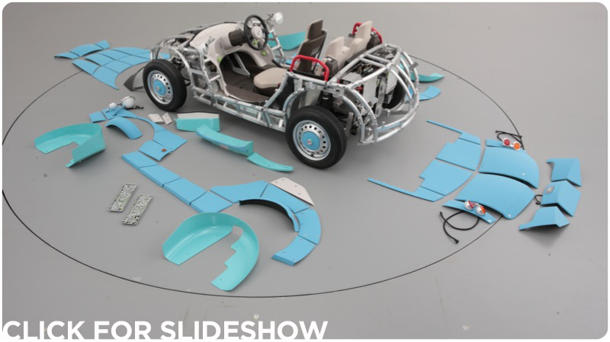
The auto industry hasn't quite figured out how to build a car that buyers assemble at home from cardboard boxes like Ikea furniture — but the latest version of Toyota's car for teaching kids to enjoy driving comes darn close.

Last year, Toyota unveiled its Camatte concept at a Tokyo toy conference, presenting the idea of a home-built, electric go-kart kit as a way to involve children in the fun of final vehicle assembly. The new Camatte57s version revealed ahead of this year's toy convention features even more parts — the 57 refers to the number of body panels — in part to make customizing a Camatte much easier. The controls have been swapped so that adults can ride side-by-side with their offspring with duplicate accelerators and brakes to help teach driving skills.

Toyota hasn't yet committed to selling the kit or said much about just how fast the Camatte 57s would roll once it's bolted together. It's not a street-legal car, and never would be, but building one looks a lot more fun than most toys — and it's hard for most parents to fit behind the wheel of a Little Tykes.


Source: Yahoo!

Tesla reveals its first profit while curbing the lowest-range Model S

In a surprise announcement late Sunday, Tesla Motors says it turned a profit for the first quarter of 2013, delivering more than 4,750 all-electric Model S sedans and beating its own forecasts. It's a major milestone for the start-up automaker, which also revealed a few last-minute Easter eggs for those waiting for their cars to be delivered — and a play to improve the value of its cars when those owners decide to sell.

Tesla had said it expected to break even on a cash basis this quarter during the ramp-up of Model S output at the factory in Fremont, Calif., with a goal of delivering 4,500 cars to owners. Since Tesla doesn't sell its cars through dealers and puts the key fob of the Model S directly in an owner's hand, it can't count the money from sold vehicles until that swap; traditional automakers mark a car as sold for accounting purposes when it leaves the factory.

"Tesla is here to stay and keep fighting for the electric car revolution,” said Elon Musk, Tesla Motors co-founder and CEO in a statement. “I would also like to thank our customers for their passionate support of the company and the car. Without them, we would not be here.”

Given the history of fledgling automakers — none of which have survived in the United States since the early 20th century — and the carnage among electric vehicle makers such as Fisker Motors, many investors have bet against Tesla, with some $1.2 billion in its shares held by short sellers anticipating its decline. Musk has aggressively fought any perceived attack on the company's image, notably launching a media war with The New York Times after one of its writers was left stranded by a Model S that ran out of charge.

That writer was testing one of Tesla's other projects, what it calls the Supercharger network of free quick-recharging stations meant to make the Model S a long-range cruiser. Using the stations requires a Tesla-specific high-voltage connector that was standard on the $72,400 Model S with an 85 kWh battery, but a $2,000 option on the shorter-range 60 kWh version. Tesla revealed tonight that buyers of the 60 kWh Model S would get the Supercharger connector for free, which it called a bet that the Superchargers will lure more customers to the company's cars.

But Tesla also revealed it was eliminating the lowest-cost planned variant of the Model S, the 40-kWh edition that had been slated to cost $52,400, or $10,000 less than the 60 kWh model. Tesla says only 4 percent of its customers had placed reservations for the 40 kWh car, which had an advertised range of 160 miles. Those customers who signed up for a 40 kWh car will get a 60 kWh car instead — but one whose software will only allow the car to access 40 kWh of energy.

Future owners — including those who buy such a capped Model S second-hand — can pay Tesla that $10,000 difference to have the software reset to use all 60 kWh of battery energy. Musk may still rank as a neophyte automaker, and Tesla's first profitable quarter doesn't solve all of its challenges, but discovering an income stream from people who buy its vehicles used will make the suits in Detroit, Tokyo and Stuttgart just a wee bit jealous.


Source: Yahoo!

Meet the man building the first new Tucker in 64 years

Inside a garage in New Jersey something remarkable is taking place. Sitting in the center of the shop is a full-size wooden model of a long-forgotten concept car called the Tucker Torpedo. The original design of the car, conceived by automotive entrepreneur Preston Tucker and designer George Lawson in 1946, would eventually evolve into the legendary Tucker '48 Sedan, of which 51 were built before the Tucker Corporation went belly up in 1949 amid accusations of stock fraud. Consequently, the Torpedo Concept, as it was originally envisioned, was never built -- until now.

Rob Ida, the builder tackling this ambitious project, is co-owner of Ida Automotive and Rob Ida Concepts, a design studio specializing in building and creating custom cars. He is a highly-regarded designer and customizer who first received international attention for his bold and meticulous recreations of the infamous Tucker '48 Sedan. Ida's inaugural Tucker, built in 2005 and dubbed the 'Lower 48', won a coveted Design Excellence award at the SEMA show that year.

Ida, 40, works with a crew of six, including his father, Bob, out of a small, unassuming shop in rural New Jersey. Finding the shop can be a challenge for first time visitors and clients; there are no neon signs, no million-dollar cars parked out front, just a garage nestled in the woods at the end of a long dirt road. "We keep a very low profile," said Ida. "Most GPS systems don't even know we are here; we kind of like it that way."

Ida has a particular fondness for Tuckers largely because his grandfather, Joe Ida, briefly owned a Tucker dealership in 1949. "He opened the dealership in Yonkers, N.Y., and took orders for three days before the Tucker Corporation was permanently shut down," Ida said, noting that what Preston Tucker promised was a nearly impossible dream. "He couldn't do it in time, he didn't have enough money, and he had too many things working against him," he said.

The Torpedo project, commissioned by noted car collector Bob Kerekes, is the most complicated, labor intensive project Ida has undertaken. “We’re trying to build it is as if the clock was turned back - as if it’s 1946, and Tucker got his wish.” To further complicate matters, the only known evidence of the Torpedo is a handful of crude drawings from 1946 and an original, quarter-scale plaster model built by designer George Lawson. "We're basically trying to create this car out of nothing," Ida said.

Ida has painstakingly assembled the full-size wooden model, or buck, using digital renderings created from the plaster model. "We know the size, profile, and compound curves the car should have," Ida said, adding that the next step will be to hand-shape dozens of pieces of aluminum and fit them to the buck.

Ida's choice to use aluminum was born out of a desire to embody the spirit of a true coach built vehicle. "The alternative would be to do it in fiberglass, or hammer it out of steel, but doing it with aluminum, and the wooden buck, and everything, is really at the higher end of coachbuilding," he said. ”We are trying to use the best materials possible."

Forming the exterior will likely be the most challenging part of the project, largely because of several engineering challenges. Ida's Torpedo will feature two butterfly doors (not to be confused with Gullwing-style doors which open straight up), two front fenders that turn with the steering wheel, and three steerable headlights. There will also be a large dorsal fin running down the center of the roof and extending past the rear engine compartment – a component that was added in later drawings of the car.

The interior will be similarly complex. Early drawings show a driver sitting in the center of the car, like the setup in a McLaren F1. "We will build it with center drive, just as Preston would have done," Ida said. "The driver will have one rotating seat in the front and there will be an additional two rotating seats in the back." As far as air conditioning, Ida has opted to leave it out. "It wouldn’t have been there in 1946."

The most innovative element of the build is Ida's idea to use modern engine components, "slightly altered," to look as though they were built in 1946. "All the technology will be new but it will appear old," said Ida, noting that once the body is built, he will install a modern, air-cooled, 6-cylinder Porsche 911 engine in the rear of the Torpedo. It will also have modern disc brakes, rack and pinion steering, and an automatic transmission – each component disguised or altered to appear from 1946.

With work now fully underway, Ida expects the Torpedo to be completed in late 2014 or early 2015. He is also clear that this project isn't about financial gain or notoriety. "It’s not about the money," he said. "If I was worried about getting paid I would take on easier projects - but that’s not what I am in to. I am rich in other ways."

The Tucker family has been an ardent supporter of Ida's previous Tucker projects and is excited to finally see the Torpedo come to life. Sean Tucker, Preston's great grandson, makes a weekly drive from his home in Bethlehem, Pa., to talk all things Tucker and to assist in the fabrication and engineering of the Torpedo. “As an engineer and Tucker descendent, it’s important to me that I keep a hands-on role in this project,” he said, staring at the wooden buck in Ida's shop. “If my great grandfather was here today and looking at what was going on, this is what he would have wanted to see. This is probably the coolest thing that has happened, Tucker-wise, since the original Tucker.”


Source: Yahoo!

2014 Mercedes-Benz SLS AMG Black, punching back: Motoramic Drives

Some cars, like the Shelby Mustang GT500, remind me of Mike Tyson; they aren’t the most agile, but if they land their famed hook, you’re out for the count. Others, like the McLaren MP4-12C, are light, precise and nimble, like Floyd Mayweather. Then you have those that lie in the middle; they pack the punch of a heavyweight, but maintain speed and agility like a welterweight. Which is to say the Mercedes-Benz SLS AMG Black Series fights like Muhammad Ali.

When you see a Mercedes with the AMG logo on the back, you know speed and aggression are of utmost importance. But when you see the words AMG Black Series, those characteristics are taken to the extreme. Like a hand-forged Samurai sword, the Black Series is designed to be sharp, precise, uncompromising and, above all, deadly. It’s the ultimate in AMG performance, taking racecar engineering onto the road.

The SLS is Mercedes’ flagship supercar; it’s brutally fast and sounds like Daboll’s foghorn. Something, however, has never quite gelled, as even the SLS AMG GT feels somewhat lethargic on-track. When AMG applied its Black Series magic to the Mercedes C63 AMG, it turned a wonderful car into a blazing, raucous animal. It’s brilliant, which means for the SLS Black Series, expectations are high.

On paper, things aren’t too dissimilar. The 6.3-liter V8 engine has been uprated to produce 622 hp (a 39-hp jump over the GT) but the 468 lb. ft of torque shows a loss of 11. Zero to 60 mph is a tenth faster than the GT at 3.5 seconds, but top speed is 1 mph less at 196.

All that, however, is somewhat irrelevant. It’s not like the SLS AMG GT needs more power, after all. What it does need is more refinement, making the following enhancements far more relevant.

Redline on the motor has been raised from 7,200 to 8,000 rpm, and gearing for the seven-speed dual clutch transmission has been shortened to optimize on-track performance, as well as being lowered 0.4 inches to improve the center of gravity. Carbon-fiber exterior mirrors, engine cover, drive shaft, and torque tube, as well as a lithium-ion battery and titanium sport exhaust shed 154 lbs., making the total curb weight 3,417 lbs.

A new electronically controlled rear-axle differential replaces the mechanical variant, allowing a variable locking effect under acceleration and deceleration, and the two-mode adaptive performance suspension has a tauter setup. Track width is increased by 0.8/0.9 inches front/rear, and lightweight wheels save weight while adding rigidity. Those wheels are fitted with larger Michelin Pilot Sport Cup 2 tires, as well as slotting around oversized two-piece carbon-ceramic brakes.

Taking cues from the SLS AMG GT3 racecar, the SLS Black is the most aggressive looking of the production SLS variants. It boasts flared fenders, tinted headlamps with black surrounds, and optimized front, rear and side skirts, as well as rear diffuser. An enlarged air intake improves cooling as well as increasing downforce, while selecting the aerodynamic package adds an adjustable carbon-fiber rear wing and carbon-fiber flicks on the skirts, again, drastically improving downforce.

The interior is not bare, as one might imagine, but is exquisitely detailed and aggressive. Carbon-fiber mixes with Alcantara to create a setting worthy of the estimated $250,000 price tag, and it even comes with a multimedia system (which track hounds can delete to save an additional 13 lbs. of weight).

The driving position is perfect and outward vision is surprisingly adequate. The tight sports seats provide excellent support and headroom is plenty when wearing a helmet. The whole car feels as expensive as a Mercedes should; in no way do you feel short-changed.


Taking to the track, any complaints that the SLS AMG GT is lethargic are immediately squashed. This is a thoroughbred racecar, a precision instrument carving the twisty course meticulously. The platform feels stable and planted, like an F-16 fighter-jet evading missile lock. The steering is responsive and receptive to subtle movements – although a little more weight would be preferable. The brakes stop as if in a head-on collision with a bulldozer, and gear changes are lightning fast and smooth.

Longer bends provide a hint of understeer, but a slight dab on the brake sets the front, rotating the rear to allow for increased throttle application. At high speed, the car is brilliantly balanced, evoking confidence to push further into the depths of possibility. This is in part due to the driver sitting over the rear axle, making you feel more in-tune with the car’s movements. While certainly agile, it’s not as light and precise as a McLaren, but perhaps that makes it more flavorful.

If I have any complaint, it would be traction out of the tighter bends. If you are not smooth and sensitive with the throttle, the rear snaps costing precious tenths of a second. Despite this, the car never feels uncontrollable or vicious. The power is seamless and aggressive throughout the range, and its booming V-8 bellows in a gloriously hostile manner.

Following legendary German racer, Bernd Schneider, we embarked on a short run maximizing every ounce of the car’s performance. Being a former racecar driver, I know what I like from a track car. The SLS AMG Black Series ticked every box, and Bernd and I had an epic battle of tire-smoke, drifting, and triple-digit speeds.

I expected this crazy, gullwinged brute to feel more like Mike Tyson: hugely powerful, slightly sluggish, but with a thump large enough to induce earthquakes. It didn’t. Instead, it floats like a butterfly, stings like a bee.


Source: Yahoo!

An old V-8 from the year you were born: Flickr photo of the day

Maybe it's age, maybe it's a fad, maybe it's a growing distance from the era when they were launched, but the early '70s Ford Torino-based cars have started looking sharper to me — especially in Ranchero form, like this 1970 example caught by True Mendez Foto. Post your photos to the Motoramic group on Flickr, or send us a message via Twitter, Facebook and Google+.


Source: Yahoo!

How one inventor wants to fight traffic cameras with a flash back

In many American cities, traffic cameras of some variety have become a way of life, giving cash-strapped local governments a fountain of new money while leaving many motorists fuming. In Washington, D.C., red-light and speed cameras brought in $85 million in 2011; one camera alone generated $11.6 million while recording more than 112,000 tickets. Now an Ohio inventor says he's created a device to legally fight back -- although those on the other side of the law may disagree.

Red-light cameras operate in 24 states across the country, while 13 states use speed cameras to tag motorists. Safety advocates have long backed the technologies; statistics show that speeding drivers trigger a majority of all auto accidents, and red-light running has been linked to thousands of accidents as well. But while many cameras were set up as safety measures, the additional revenue -- up to $500 a ticket in some jurisdictions -- has spurred a backlash; in all, 12 states have barred speed cameras and nine states have outlawed red-light camera tickets, with dozens of cities debating the question.

Speed and red-light cameras work in part because all states make it illegal to obscure your license plate -- and there's no magic spray that keeps the plates hidden from cameras but visible all other times. Jonathan Dandrow, an Ohio tinkerer, decided to research ways to make photos taken by the cameras useless, but otherwise leave the plate visible. After two years of work in his garage, Dandrow came up with noPhoto, a license plate frame that conceals two powerful xenon light units and electronics that trigger them only when they sense a flash from the traffic camera.

The trick, according to Dandrow, was writing software that would recognize the unique flash created by a traffic camera while ignoring all other light sources. Another key hurdle was creating a burst of light bright enough that a photo couldn't be easily manipulated to reveal the numbers. In the video above, Dandrow says a prototype version responds to traffic camera strobe from over 100 feet away in broad daylight.

Dandrow calls his invention a response to drivers being "constantly monitored and watched," and that motorists shouldn't lose challenges to traffic citations "just because it happens to be (from) a camera that can't talk in court." And he maintains that because the noPhoto does not block the view of the license plate, it's legal today in most states.

But not all states. In North Carolina, police can cite motorists for installing license plate frames that "prevent or interfere with the taking of a clear photograph" of a license plate, while other states have less clearly worded restrictions on license plate frames that could be used against noPhoto. Previous challenges to red-light and speed camera enforcement has spurred state lawmakers to write new statues protecting such revenue with a quickness. And noPhoto may raise more concerns if it's proven effective against cameras meant to catch toll-road freeloaders.

Dandrow's device also raises concerns of safety advocates. "There is a simple solution for not receiving red light and speeding tickets — stop running red lights and stop speeding," said David Kelly, former chief of the National Highway Traffic Safety Administration and the head of the National Coalition for Safer Roads, a group supported in part by photo enforcement firms. "Instead of driving safely, scofflaws continue to recklessly put others in danger."

Dandrow is still raising money to develop his invention, which he plans to sell for $350 a copy, a price that could keep it from being a widespread countermeasure. If it does catch on, Dandrow will find himself under a different kind of spotlight -- with cities around the country chasing money they expected in their accounts, not his.


Source: Yahoo!

BMW building two-man bobsled for U.S. Olympic team

For a luxury carbuilder, BMW has been expanding in all directions as of late. On Tuesday, it held a swanky event in New York for its upcoming i3 and i8 hybrids with Uma Thurman. Two months ago, it showed off its first front-wheel-drive car. But the newest BMW vehicle goes even more green by using only gravity and foot power -- a two-man bobsled for the U.S. Olympic team to use at the 2014 games in Sochi, Russia.

As one of the title sponsors of the U.S. Olympic teams, BMW has lent the expertise of its U.S. engineers to sports, helping long jumpers perfect their form for the summer games. BMW says its DesignworksUSA studio in California was asked to help the two-man team build a better ride; the current bobsled design was 20 years old, and the United States hasn't won a gold in the two-man version of the race since 1936 -- and has been shut out of all medals in the sport since 1952. (The two-women U.S. team has been more successful, but only won a bronze in 2010).

After analyzing the sled for aerodynamics and better materials, BMW says it spent a year refining its ideas before delivering a prototype to the USA Bobsled & Skeleton Federation, which will give the automaker feedback over the next year before the Sochi games. While a big sled might have little in common with a BMW at first glance, a two-man bobsled can reach 75 mph and must weigh 860 lbs. -- making it closer to a custom-built race car than the Radio Flyer sled in your garage. At least this will be one BMW that won't have to worry about generating fake noises for its occupants.


Source: Yahoo!

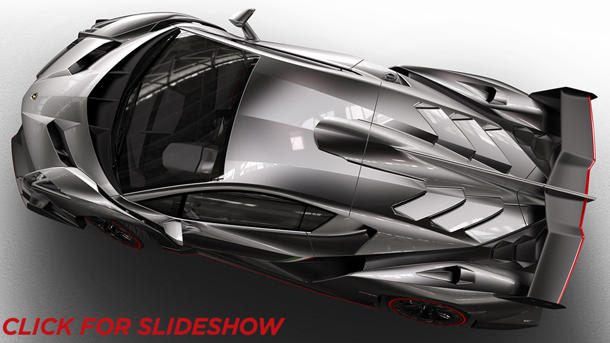
The Lamborghini Veneno, a $4 million supercar for three owners, leaks pre-Geneva

Of all the world's supercar makers, none stretch the idea of an ultimate sports machine quite so far as Lamborghini. For its 50th anniversary, the Italian automaker has created its most bizarre car yet: Meet the Veneno, a $4 million alien craft that will be assembled for only three buyers who've already put down their deposits — and being sold out before it goes into production is only a hint of the Veneno's speed. 

Built from the Aventador chassis, Lamborghini says the Veneno was designed to come as close as possible to a Le Mans-quality race car that's still usable on public roads. Power comes from a 740-hp version of the Aventador's 6.5-liter V-12 linked to a 7-speed automated manual transmission and permanent all-wheel-drive, good for a top speed of 220 mph and 60 mph in less than three seconds.

Named for a Spanish fighting bull that killed a toreador in 1914, the Veneno uses carbon fiber everywhere, from the tweaked Avendator chassis to the body and interior controls. Even the wheels wear a carbon fiber ring that Lamborghini claims acts like a vortex to shunt air toward the brakes for cooling.

The three copies of the monster from Sant'Agata Bolognese that Lamborghini plans to build will have red, white, or green touches to match the Italian flag; technically, there will be four copies including the test model Lamborghini plans to hold onto. With two of the buyers hailing from the United States, the Veneno will soon enter the rarefied realm of personalized exotic cars — but its fortunate owners would do well to remember what happens when you mess with the bull.


Source: Yahoo!

2014 Mercedes-Benz SLS AMG Electric Drive, a real shocker: Motoramic Drives

When you’re told you will be driving an electric car around a racetrack, seldom do you get excited. It’s not that you won’t have fun – driving a Nissan Leaf on-track is enjoyable – but you’d rather be driving something with more power than your typical airport rental. At the Paul Ricard circuit, in southern France, I had the chance to drive an electric race car, the $522,000, 740-hp Mercedes-Benz SLS AMG Electric Drive, also known as the fastest production EV in the world.

As we arrived at the track, we were ushered into a decked-out pit lane garage, with cut-away cars showcasing technology, and a beverage station against the back wall. Immediately a blue glow, glistening in the Mediterranean sun, caught my attention.

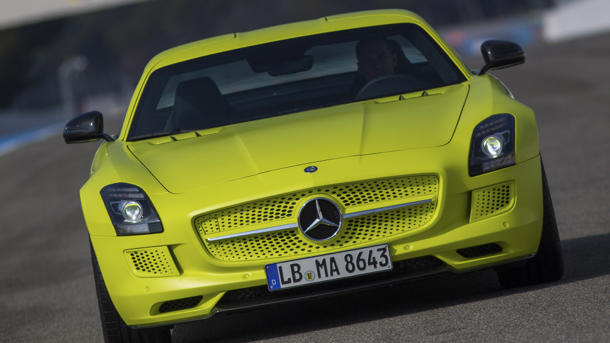
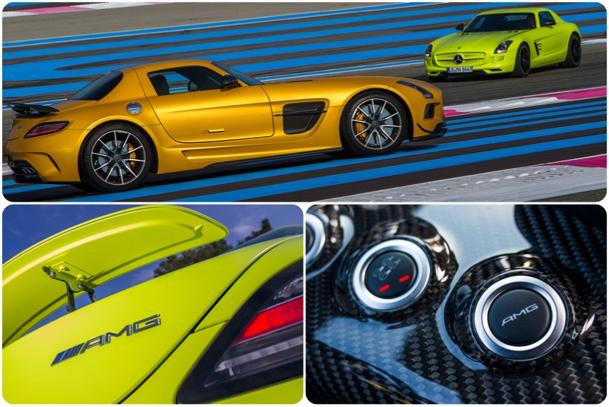
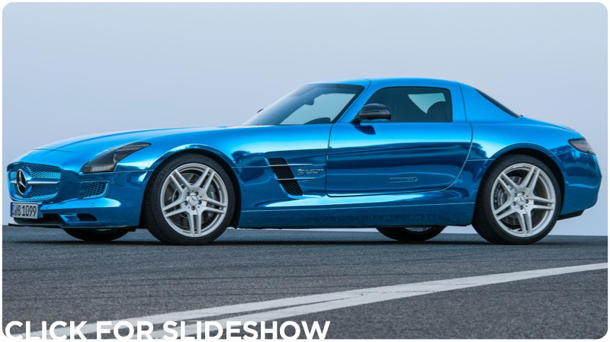
Peering out of the garage, I saw a Mercedes SLS garnished in the most eye-catching, over-the-top, ghastly chrome blue coloring. Next to it was an equally flamboyant aluminous yellow version. The Day-Glo colors typically not seen on vehicles outside Sir Elton John's garage are just the beginning of what make these cars unlike anything else in the world.

The SLS stands as Mercedes’ flagship model, boasting super-car performance, aggressive styling, and a price tag fitting only the wealthiest of speed freaks; when you add AMG to the title, these attributes only heighten. Unlike other supercars, these were attached to 22kW power outlets, readying for a select group to sample their revolutionary bite.

What makes them incredible? For starters, they have four electric motors – each powering a separate wheel, a unique set-up in the world of electric cars. This makes the SLS Electric all-wheel drive, but its benefits run deeper. By powering the wheels independently, with magnet synchronous motors, the torque can flow precisely to each corner. A button on the center console chooses between three settings: Comfort, Sport, and Sport Plus. Comfort is the least aggressive, leaving the car with a healthy chunk of understeer. Sport provides more power to the outside wheels during cornering to create a neutral balance, whereas Sport Plus delivers the most aggressive torque vectoring, turning the car into a tire-smoking drift-machine.

As I readied to climb into the bright yellow gullwing, an AMG engineer read the spec sheet out: “740 horsepower, 738 foot-pounds of torque, zero to 62 mph in 3.9 seconds. This is the most technologically advanced electric vehicle ever made,” he said. “With today’s capabilities, you cannot achieve more.”

Color me intrigued.
As I fastened my seat belt and adjusted the seat position, the AMG engineer jumped in the passenger seat. He began explaining how closely they worked with the Mercedes Formula One engineers, given their experience with batteries used in the team’s KERS system.

The high-voltage batteries consist of 12 modules, each with 72 lithium-ion cells. Regeneration occurs during deceleration, but the rate can be increased or decreased by clicking the paddle shifters behind the suede-wrapped steering wheel.

Batteries delivering this much power need an equally impressive cooling system. In the SLS Electric, two low-temperature cooling circuits ensure the conditions remain optimum. With a three-phase, 22-kilowatt charging system, the 60 kWh batteries can be charged in just three hours. With a normal plug, it takes around 20 hours. A full charge can take the SLS 155 miles.

Having become more familiar with the mechanics of the SLS Electric, I was ready to hit the asphalt. An AMG button on the center console reduces power, responsiveness, and generally makes the car docile. Like the torque-vectoring button, there are three settings: Comfort, Sport, and Sport Plus. We started out in Comfort.

With an eerie silence (there is a button that makes fake engine noise if you prefer), we pull onto the track. You have to press the throttle hard and it feels remarkably calm (and slow). But that is exactly what you want in Comfort mode: a car that cruises effortlessly in day-to-day traffic. After a couple of laps, the AMG engineer looks at me with a smile and says, “You ready?”

“Indeed I am,” I reply, as he presses the button, skipping Sport mode altogether, moving straight to Sport Plus and igniting the full muscle of the SLS Electric.

Immediately the car sprung to life, life a giant swordfish fighting a tourist's hook. The entire 748 ft-lbs of torque is available with every touch of the throttle. We turn the torque vectoring system to Sport Plus too, engaging the most aggressive driving dynamics possible. It was time to see what this astounding piece of engineering could do.
The steering is amazingly precise, light, and nimble. It’s worth noting that the weighty electric motors and batteries add roughly 1,200 lbs. over the standard SLS AMG. That’s a lot, and you would think it drastically kills performance. No doubt you can feel it, but a 1 cm reduction in the center of gravity, due to the excess mass being fitted on the floor, helps offset the deficiency.

The weight does produce more body roll, and, with torque vectoring in Sport Plus mode, the back end wants to slide incessantly. It does so, however, in a way that’s controllable — and a hell of a lot of fun. But if that’s not your style, going back to Sport mode delivers the perfect neutral balance. The ability to dramatically adjust the handling is amazing, modifying the car’s behavior to suit your individual needs.

With such a surfeit of instant torque, you might think the throttle would be jerky and unpredictable. It isn’t. Due to a longer drive ratio, powering the car up to 155 mph, the initial launch is not as demonic as you’d expect, or perhaps even desire. Without question, it’s extremely rapid, but it’s not as quick as the SLS Black Series — even though it has more total power — due to its hefty weight.

Despite this, the car’s performance on track is astonishing. Is it as good as its brutish combustion engined twin? No. But it doesn’t have to be. The technology is fascinating and proves that EVs can be dynamic and exciting to drive.

Amazing creations, such as the SLS Electric, are not immune to problems, however. As I exited a hairpin bend, the whistle from the motor stopped. I ground to a halt, with warning lights illuminating the dash in illegible German. From what little I could translate, it appeared to be a fault with the batteries.

Despite the engineer’s obvious embarrassment, I showcased a grin from ear to ear. After all, who drifts an EV? But, with the SLS Electric going on sale in June, problems like this are worrying.

As I returned to the garage, other journalists looked on with a level of intrigue rarely detected. The SLS Electric made an impression on everyone. It’s like glimpsing into the future, with its bold colors, revolutionary technology, and mind-blowing price tag.

Yet despite the excellence of the SLS Electric Drive, it wouldn’t replace the traditional combustion engine; but, if I had half a million bucks to blow, it would make a fabulous sidekick. It’s not available in America, so I’d have to move to Europe, and I’d probably need some new shoes to match its effervescent styling. I’d likely have to befriend Sir Elton John, too, but it’d all be worthwhile. After all, it’s an electric supercar that can drift.


Source: Yahoo!

Retractable revolution: Flickr photo of the day

It doesn't seem long ago most convertibles came with the usual cloth-roof; after all they're lighter than the hardtop convertible and take up less luggage space. The benefit of combining both the hardtop and cloth-top variants into one package, however, remains undeniable, and over the years this philosophy has become common. America's Ford Motor Company offered the 1957 Fairlane 500 Skyliner - pictured above courtesy of DVS1mn - as one of the first retractable hardtops in the world. The car didn't sell particularly well, and trunk space was severely compromised, but it stands as one of the instigators that started the retractable hardtop revolution. Be sure to watch Ford's commercial on the Skyliner below, and if you have a shot to share, add it to the Motoramic group on Flickr, or send us a message via Twitter, Facebookand Google+.


Source: Yahoo!

Thursday, October 31, 2013

All dressed up for Halloween: Flickr photo of the day

For Halloween, it's only appropriate to note cars masquerading as other models, like this VW Bug caught by jwhanley posing as a Ford roadster.  This shot comes from the Motoramic group on Flickr; you can add your photos there, or send us a message via Twitter, Facebook, and Google+.


Source: Yahoo!
Proof that racing takes talent from a Ford GT40 in the rain

IndyCar fans know the name Kenny Bräck well, from his win of the 1999 Indianapolis 500 and his horrifying crash at Texas Motor Speedway that he barely survived and required 18 months of recovery. Bräck has since retired from open-wheel racing, but he runs a few laps here and there — and this video of his drive in a 1966 Ford GT40 at the wet Goodwood circuit in England last weekend has only served to remind the world just how good of a driver he was.

Controlling any race car in a hard rain takes skill; running a million-dollar classic whose steering wheel is twitching like a squirrel in a meth lab requires a rare amount of talent. Within the first five seconds of this qualifying lap at the Goodwood Revival, another GT40 runs off course, yet Brack never lets up. If only all 47-year-olds were so good behind the wheel. 


Source: Yahoo!